The Rules
Understanding the Hockey Rink
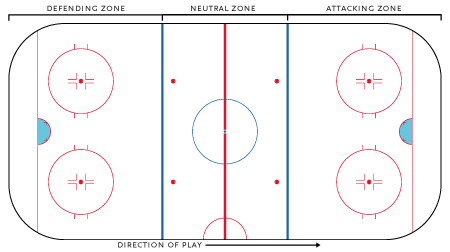
A hockey rink is a rectangle with rounded corners — think of it like a swimming pool.
At each short end of the rink is a half-circle painted in front of the net. This area is called the goal crease, and it belongs to the goalie. The net sits on the goal line at the edge of this crease.
In the center of the rink is a large circle with a dot in the middle. This is where the game starts and restarts after goals.
Two solid blue lines sit on either side of center ice. These lines divide the rink into three sections.
Near each goal are two smaller circles called faceoff circles, where play restarts after stoppages in that zone.
The rest of the markings can be ignored for now — they’ll make sense as you learn the game.
Gameplay Mistakes
Common Penalties (The Important Ones)
This is where most beginners get confused — and where most penalties happen.
Tripping
Using your stick, leg, or foot to cause another player to fall.
Hooking
Using your stick to slow down or restrict an opponent.
If your stick wraps around their body or hands, it’s usually hooking.
Slashing
Swinging your stick at another player, often at their hands or stick.
Holding
Grabbing or restraining an opponent with your hands or arms.
Interference
Making contact with a player who does not have the puck.
Cross-Checking
Using both hands on your stick to forcefully push an opponent.
High-Sticking
Making contact with another player using a stick raised above shoulder height.
Boarding
Hitting a player dangerously into the boards.
Charging
Taking multiple strides before delivering a hit.
Roughing
Minor fights, shoving, or unnecessary physical play, often after the whistle.
Penalty Time
Most penalties result in two minutes in the penalty box.
More serious penalties can result in:
Four minutes (double minor)
Five minutes (major penalty)
While a player is in the box, their team must play short-handed.
This gives the other team a power play.
Offsides
Offsides occurs when a player enters the offensive zone before the puck.
To stay onside, a player must keep at least one skate on or behind the blue line until the puck enters the zone.
If a team is offside, all attacking players must clear the zone before re-entering.
Icing
Icing happens when a player shoots the puck from their own side of the ice past the opponent’s goal line without it being touched.
When icing is called:
Play stops
A faceoff occurs in the offending team’s zone
Icing exists to prevent teams from simply dumping the puck down the ice to avoid pressure.
How Long the Game Lasts
A hockey game is played in three periods, each lasting 20 minutes.
The clock stops whenever play stops, so games usually last much longer than an hour.
Final Thought
The rules might feel overwhelming at first, but most penalties come down to one idea:
If it looks dangerous, unfair, or reckless, it’s probably a penalty.
Once you play or watch enough hockey, these rules start to feel natural.